| Bridget
Smith-Konter Department of Geology and Geophysics University of Hawaii at Manoa Honolulu, HI 96822 http://www.soest.hawaii.edu/GG/FACULTY/smithkonter/ |
David
Sandwell
Scripps
Institution of OceanographyInstitute of Geophysics and Planetary Physics University of California, San Diego La Jolla, CA 92093-0225 http://topex.ucsd.edu/sandwell |
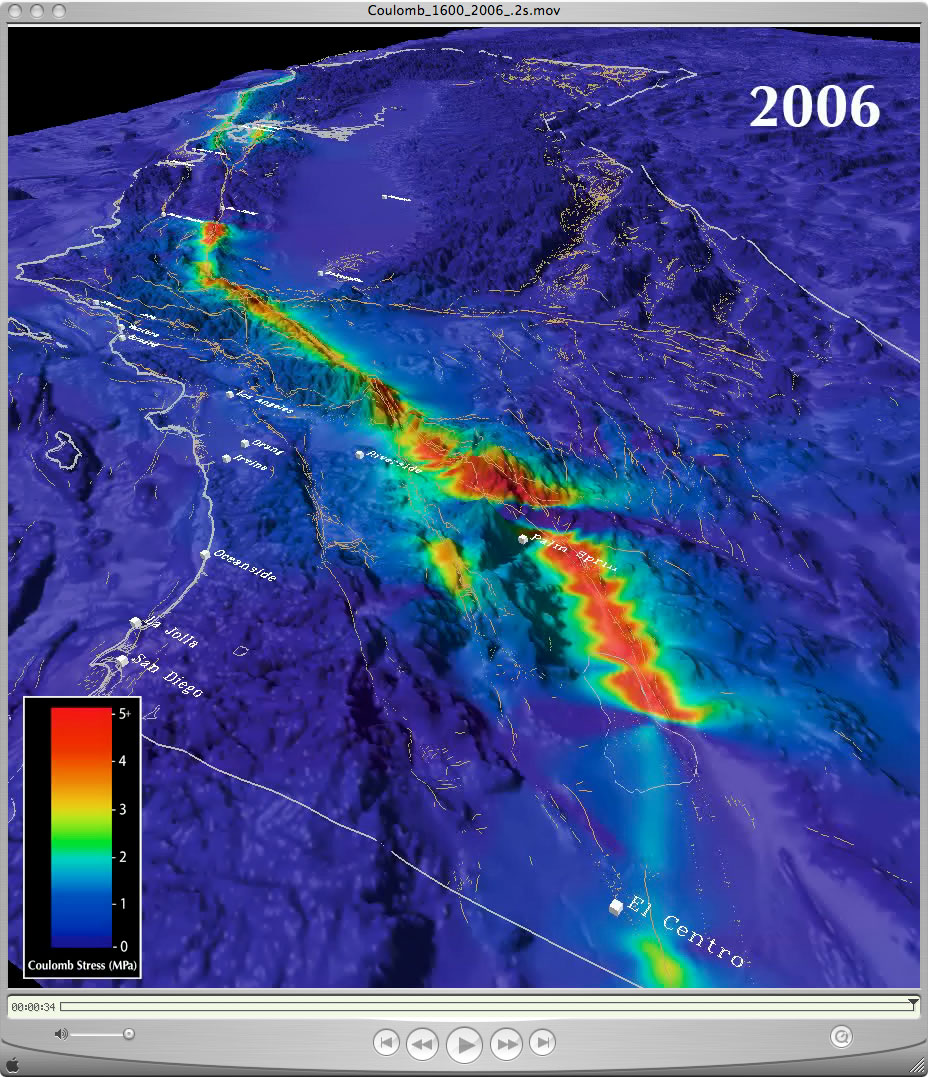
| Long-term
tectonic
loading, instantaneous fault rupture, and transient
postseismic rebound are key components of the earthquake cycle
that
expose important spatial and temporal chaaracteristics of
crustal
deformation. In order to better understand such behavior, we
have
developed semi-analytic elastic and viscoelastic (static and
time-dependent) models for 3-D displacement and stress caused
by a
body-force dislocation. All solutions of the model are derived
(and
computed) in the Fourier domain to exploit the speed of the
convolution
theorem and thus horizontal complexity of a model fault system
has no
effect on the speed of the computation. A single-depth
computation
consisting of a horizontal grid of 2048x2048 elements, for
example,
requires less than 40 seconds of CPU time on a Mac G5.
|
This
research
was supported by the NASA Solid Earth and Natural Hazards
Program (NAGS - 9623), the NASA Earth System Science
Fellowship Program
(ESSF - 0131), the NSF Earth Science Program (EAR -
0105896), and
the Southern California Earthquake Center (SCEC).
Institute of Geophysics and Planetary Physics
Scripps Institution of Oceanography
University of California, San Diego
Institute of Geophysics and Planetary Physics
Scripps Institution of Oceanography
University of California, San Diego